tech

Semantic Web Technologies

Posted in research, semantic_web on September 29th, 2008 by donturn – Be the first to comment

This Fall 2008 semester at the University of Texas, I’m teaching a course on: Semantic Web Technologies

This course approaches understanding Semantic Web technologies from three perspectives:

  • Top-down, theoretical approaches to organizing semantic information including ontologies, taxonomies, knowledge representation and software agents.
  • Bottom-up approaches, sometimes called “emergent semantics” or “the lower case ‘S’ semantic web”, for understanding and creating networked information including XML-based solutions including RDF, XPath and RSS. Also included are smaller, informal systems for organizing Web information including tagging (social bookmarking), microformats and other specific markup and distribution systems.
  • Application approaches focusing on Web Services or “Web 2.0″ functionality including distributed (client and server) application design, syndication, Application Programming Interfaces, remote databases and “mash-ups”.

Of course, we have a class blog too: Semantic Web Technologies Blog.

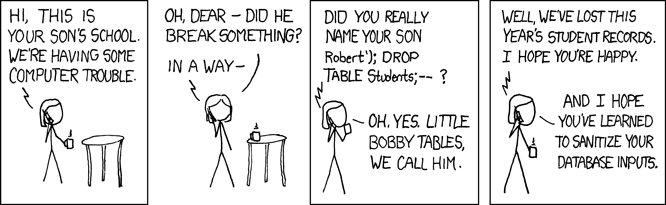
SQL Humor

Posted in tech on October 10th, 2007 by donturn – Be the first to comment

It’s either really good or really bad that I enjoyed this so much:

xkcd.com

xkcd – A webcomic of romance, sarcasm, math, and language – By Randall Munroe

(Ah, SQL92, you’ve been so good to us with your dynamic query execs.)

Get ready for the 2008 Information Architecture Summit

Posted in information_architecture, science, tech, travel on September 19th, 2007 by donturn – Be the first to comment

On another IA note (can you tell I’m working through my inbox?) it’s time again to start thinking about the 2008 Information Architecture Summit in Miami, Florida on April 10-14 2008.

The Information Architecture Summit is the premier gathering place for those interested in information architecture. The 2007 IA Summit attracted over 570 attendees, including beginners, experienced IAs, and people from a range of related fields.

The 2008 theme of “Experiencing Information” shifts the focus back to users. A user experience exists only to allow people to “do things” (in the broadest sense … buying books, sharing photos with friends, looking something up on wikipedia, etc).

Call for Proposals

The summit is a great opportunity to share your experience and thoughts on a topic you feel passionate about – and for the first time – presenters will receive complimentary registration! (to keep costs manageable one complimentary registration will be given to each regular session slot and panel moderator/organizer).

Proposals for the following are due October 31, 2007:

  • Presentations
  • Panels
  • Posters
  • Management Track
  • Pre-conference workshops

Submissions of peer-reviewed Research Papers are due November 30, 2007.

(Note that I’m a member of the IAI Advisory Board and will be a reviewer for Proposal and Research Papers. If you have any questions about the proposal process, the IA Summit or the Information Architecture Institute just ask.)

Information Architecture Institute Progress Grants

Posted in information_architecture, research, science, tech on September 19th, 2007 by donturn – Be the first to comment

I’m pleased to announce (or remind) that the Information Architecture Institute is accepting applications for the Information Architecture 2007 Progress Grants

The Information Architecture Institute (IAI) will award two USD $1,000 Progress Grants for 2007. The purpose of the program is twofold:

  • to encourage researchers and practitioners to investigate IA-specific issues
  • to publicize useful work that furthers the information architecture body of knowledge

Applications should propose work that will forward the theory and practice of information architecture. This can include original research, a synthesis of important existing research, or the development of an innovative new technique.

The IAI Progress Grant Committee will review the proposals and select those with the highest potential to benefit the information architecture field. Half of the grant amount will be awarded when the grant recipients are announced and half when the work is completed. Progress grants will only be awarded to proposals of sufficient quality, clarity, and originality.

Work supported through this program will be published on the iainstitute.org website, but it should have relevance beyond the Tools and Library collections. For instance, the work could inform future IAI workshop curricula, tie in with potential Institute publishing projects, be responsive to issues raised by members in the email discussion list, or support other Institute activities, such as Local Groups and International initiatives.

The application deadline for applying is October 15, 2007

Applications should be 2,000 words or fewer and must contain:

  • Description of the problem or hypothesis
  • Methodology to be used
  • Explanation of how the resulting work will forward the theory or practice of IA
  • Conditions under which others can use the results (e.g. Creative Commons license)

(Note that I’m on the Awards Jury Committee for this grant.)

Learn more about the Information Architecture 2007 Progress Grants now.

Creating Interactive Prototypes with PowerPoint

Posted in information_architecture, mac, tech on August 7th, 2007 by donturn – Be the first to comment

Maureen Kelly over at Boxes and Arrows has a nice article about building Interactive Prototypes with PowerPoint.

PowerPoint prototypes are a great way to show someone how the flow of an interaction might work and even better, you can send them the .ppt file to view before or after your demo, not to mention ensuring that almost everyone you work with could (if you want them to) contribute to the PowerPoint deck since the application is nearly ubiquitous.

As an aside, I’m always a bit impressed with the ingenuity of people who live in one application for everything, and PP certainly can let you do that. I’ve known many people that use PP for note taking, article reviewing (guilty!) and of course outlining (it’s better than Microsoft Word). However, this is nothing compared to the people who used to live in Lotus 123 including writing memos and even formatting floppies. (Ah, floppy disks.)

Fear Sugar Manna

Posted in search, tech on June 6th, 2007 by donturn – Be the first to comment

If anagrams are fun, then the Internet Anagram Server is more fun.

Well, to me.

Rating, Voting & Ranking: Designing for Collaboration & Consensus at CHI 2007

Posted in information_architecture, search, semantic_web, tech on April 30th, 2007 by donturn – Be the first to comment

I’m in San Jose, California presenting a Works-in-Progress paper at the Association for Computing Machinery’s (ACM) Computer-Human Interface (CHI) 2007 conference. I’m showing off some of the interface design issues related to encouraging valid, fluid participation for a community-based internet content filter we’re developing at the University of Texas at Austin called OpenChoice.

Here’s the abstract for the paper:

The OpenChoice system, currently in development, is an open source, open access community rating and filtering service that would improve upon the utility of currently available Web content filters. The goal of OpenChoice is to encourage community involvement in making filtering classification more accurate and to increase awareness in the current approaches to content filtering. The design challenge for OpenChoice is to find the best interfaces for encouraging easy participation amongst a community of users, be it for voting, rating or discussing Web page content. This work in progress reviews some initial designs while reviewing best practices and designs from popular Web portals and community sites.

I’m also making it available to download: Turnbull, Don (2007) Rating, Voting & Ranking: Designing for Collaboration & Consensus. Works-in-Progress Paper presented at the ACM SIGCHI Conference. San Jose, CA. May 2, 2007.

CHI challenge: how many photos tagged with chi2007?

Posted in media, tech on April 30th, 2007 by donturn – Be the first to comment

I’m predicting 2,500 Flickr photos tagged with chi2007 by Friday morning.

What’s your guess?

Update: Since there are 7,704 photos with the chi2006 tag, I may be underestimating.

Update on the Update: As of May 29, there are 3,341 photos with the chi2007 tag.

Listening Post exhibit at the San Jose Museum of Art

Posted in media, tech, travel on April 30th, 2007 by donturn – Be the first to comment

Yesterday I saw an interesting exhibit called Listening Post at the San Jose Museum of Art about understanding, or maybe just observing, internet-based communications.

Here’s the blurb from the project’s Web page:

“What would 100,000 people chatting on the Internet sound and look like?”… Listening Post analyzes all the text—typed just moments ago—by tens of thousands of people in Internet chat rooms around the world. It presents them as six different “movements,” combining musical tones, sound effects, synthesized voice, and scrolling text. For example, in the first movement, Listening Post monitors and displays a randomly typed text beginning with “I am.” It then searches the Internet for related phrases, creating a simultaneously funny, sad, nonsensical, pathetic, yearning, quotidian, and ultimately mesmerizing tonal poem of identity in the Internet age.

For centuries, the soaring buttresses, vaulted ceilings, and luminous stained glass of cathedrals, along with hymns and chants, have transmitted that which is beyond expression. Using algorithms, software, and data mining, Listening Post generates a similar experience around what sometimes seems beyond comprehension.

It’s quite an experience with seven “movements” that range from ideas like Wave Cycle, Topic Cluster and I Am (I Like/I Love) where text from the messages floats, drifts or cycles across the many small LED screens in sync with some Philip Glass-like music.

Listening Post

The exhibit runs Saturday, June 3, 2006 through Sunday, May 20, 2007, so hurry up and take a look while it’s still there.

Nature says Happy (300th) Birthday to Linnaeus

Posted in information_architecture, semantic_web on April 23rd, 2007 by donturn – Be the first to comment

The journal/magazine Nature has a special issue to celebrate the birthday of Linnaeus, who most think of as originating the idea of large-scale classification to understand the world and normalize scientific research.

Carl Linnaeus introduced the systematic classification upon which all subsequent natural history has been built. This Nature web focus brings together a range of material celebrating the tercentenary of his birth in 1707, including features on how the explosion of genetic data changes the way we look at taxonomy, and the conflict between professionals and amateurs when naming species. There are also commentaries by leading taxonomists on the future of their field, articles on Linnaeus’s global network of contacts and even his lost and lamented pet raccoon, original research on the origin of flowering plants and a review on speciation – the first of several such articles to be published this year, which will be added to the web focus over time along with other coverage.

The issue is behind a paywall. How would Linnaeus classify that?